NEW DELHI: Since its February coup, the army leaders in Myanmar have been doing all it might probably to entrench power, legitimise its actions and solidify the new establishment.
However, the junta has suffered setbacks on all fronts.
On the home entrance, the army has confronted robust protests over the previous month, bolstered by the ongoing widespread civil disobedience motion from folks from all walks of life, which now embrace the closure of retailers, factories and banks.
Demonstrations haven’t abated, regardless of safety forces killing greater than 60 and detaining greater than 1,800, amid blackouts imposed on social media and the cancellation of licenses held by 5 native media shops.
READ: Commentary: With violent crackdowns, is Myanmar passing the point of no return?
The army has resorted to more and more aggressive actions to clamp down on dissent, together with in a single day blockades to catch protesters violating curfews in Yangon.
A COURAGEOUS ACT
On the worldwide entrance, some main developments threaten to maintain the problem on the international agenda.
The first main setback for the army got here on Feb 26 when Myanmar’s United Nations ambassador Kyaw Moe Tun, in what many described it as a courageous act whereas addressing the 193-member UN General Assembly, appealed to the UN “to use any means necessary to take action against the Myanmar military” to revive democracy.
He ended his speech with a three-fingered salute.
The ambassador’s motion was motivated by not less than 4 components. First, he was appointed by the ousted National League for Democracy (NLD) authorities. It was a matter of loyalty to the get together, the authorities and its management.

Aung San Suu Kyi has not been seen since she was detained in a daybreak raid. (Photo: AFP/Sai Aung Main)
Second, the ambassador himself disapproved of the usurping of power from a democratically elected authorities. Despite the military’s allegation of electoral fraud, there has not been substantive proof supporting such claims.
Third, the ambassador was shocked, and maybe disgusted by the use of deadly pressure and violence on largely peaceable protesters.
Fourth, the ambassador was in all probability emboldened by the speech of the UN Secretary-General Antonio Guterres’ particular envoy on Myanmar, Christine Schraner Burgener, when she warned that no country should recognise or legitimise the Myanmar junta that very same day.
READ: Commentary: Has Myanmar coup sparked rethinking on non-interference among ASEAN countries?
FIRED BUT NOT ALONE
Unsurprisingly, a day after his emotional speech at the General Assembly, the Myanmar junta fired Kyaw Moe Tun and named his deputy Tin Maung Naing the nation’s appearing UN envoy. Kyaw Moe Tun refused to capitulate to the military’s order.
There was brief confusion over who represented Myanmar at the UN. Thankfully, Tin Maung Naing cleared issues up by resigning.
Their resistance has galvanised help inside Myanmar’s diplomatic circles to oppose the army. On Thursday (Mar 4), the Myanmar embassy in Washington DC issued a press release denouncing the civilian deaths and known as for safety forces to “fully exercise utmost restraint”.
READ: Commentary: Myanmar coup poses first foreign policy test for Biden on Southeast Asia
READ: Commentary: US sanctions on Myanmar will not reverse the coup
And on Monday (Mar 8), Myanmar’s ambassador to Britain Kyaw Zwar Minn known as for the launch of ousted State Counsellor Aung San Suu Kyi and President Win Myint and stated {that a} peaceable negotiation should be the answer to the nation’s issues.
Having this many high-level diplomats break ranks with the junta may win the Myanmar protesters allies and harden worldwide opposition to the coup. UK Foreign Secretary Dominic Raab has since praised Kyaw Zwar Minn’s “courage and patriotism” and stated the UK joins him in his name for the speedy launch of Aung San Suu Kyi and a return to democratic rule.
The Myanmar army regime is aware of this can be a harmful improvement. They have accused its UN envoy of “high treason” for insisting he represents the NLD authorities, in an try and scare its diplomats.

Britain’s Foreign Affairs Secretary Dominic Raab appears on as he walks outdoors Downing Street in London, Britain, February 24, 2021. (Photo: REUTERS/John Sibley)
It has additionally tried to recall over 100 employees from abroad missions together with the US, UK, China, Japan and India, to little avail.
It stays to be seen how the UN may cope with a scenario the place the Myanmar army once more makes an attempt to exchange its UN envoy, although the UN General Assembly may name for a vote after the UN accreditation and protocol committees study the information of the case, as UN spokesman Stephane Dujarric outlined final week. The UN neighborhood shouldn’t be prone to settle for a change.
LACKING LEGITIMACY
This diplomatic mutiny is elevating uncomfortable conversations about Myanmar’s coup and invidious comparisons with these in Thailand and Indonesia in international diplomatic circles.
For one, the Royal Thai Armed Forces enjoys a robust base of help, and is seen as a stabilising pressure holding Thailand collectively.
The nation has suffered deep divisions over the final 15 years, with relentless political contestation entrenching the positions of nationalistic royalists on the one aspect and democratic forces championing the rights of odd Thais on the different. People have bored with disaster.
READ: Commentary: To be president? What Myanmar military leader’s endgame may be
READ: Commentary: The Milk Tea Alliance sweeping through Thailand is a force to be reckoned with
Today, the Thai army has not solely the help of city elites but additionally the approval of the Thai palace, which has been a well-liked, highly effective pressure for hundreds of years revered by massive swaths of the Thai populace.
In distinction, there is no such thing as a such single highly effective establishment restraining the Myanmar military’s actions. Buddhist monks are extremely revered in this predominantly Buddhist society, comprising practically 90 per cent of the inhabitants, however the 2007 Saffron Revolution confirmed that the nation’s safety forces won’t hesitant to make use of lethal pressure on them.
The Myanmar junta must also not be in comparison with Suharto’s New Order regime, which assumed power in Indonesia in 1967 after ousting President Sukarno and stepped down after the Asian Financial Crisis in 1998. In Suharto was nationwide curiosity, get together curiosity and private curiosity consolidated in one man.
READ: Commentary: ASEAN can do better on Myanmar this time
Yet, as soon as Suharto knew he had misplaced all help of his Cabinet, he resigned.
Let’s additionally not neglect that the Indonesian Armed Forces (TNI) have been cooperative with bureaucratic reforms since then to scale back its deep involvement in civilian life, together with the abolishment of army positions in parliament, the ending of the TNI’s enterprise actions and the separation of inside safety tasks to kind the Indonesian Police Force that’s impartial of the armed forces.
Unlike in Indonesia, the place politics had been finally ceded to democratically elected political leaders, the army in Myanmar desires to be the chief architect of the nation’s political transition which it calls a “genuine and disciplined-flourishing democracy”.
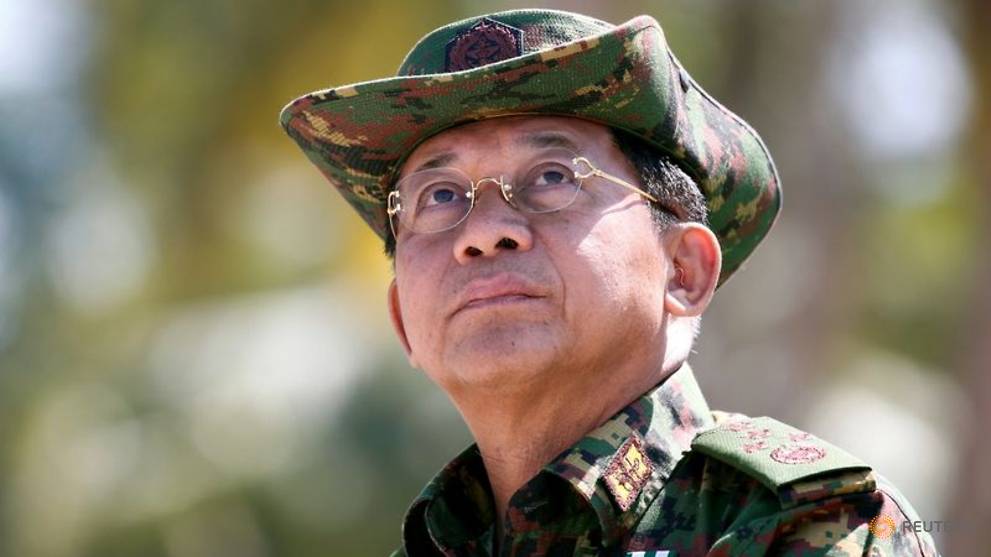
File photograph of Myanmar army commander-in-chief, Senior General Min Aung Hlaing in February 2018. (Photo: Reuters/Lynn Bo Bo/Pool)
It desires to take pleasure in the advantages of democracy and kind a part of the worldwide neighborhood, however it doesn’t wish to surrender its inherent position in politics.
Following the first army coup by General Ne Win in 1962, Myanmar adopted what it known as the “Burmese Way to Socialism”, a mix of socialism with an inherent position for the army. Following the 2011 political transition, Myanmar took an identical strategy.
WHAT DIPLOMATIC PROTESTS COULD AMOUNT TO
What is evident is that the defiance by Myanmar’s diplomats will preserve the nation’s coup on the worldwide neighborhood’s radar for a while.
But what is going to come out of it? Of course, the Myanmar army will be pressured to relinquish their power ought to the UN Security Council determine to take a decisive motion below Chapter VII of the UN Chapter, which incorporates the use of pressure.
Even a coalition of the keen, just like what the US pursued in Iraq years in the past, can completely change the behaviour of the Myanmar army.
But such a chance is extremely distant. Neither the US nor any overseas power will go to such lengths once they themselves are slowed down with home priorities.
Interestingly, maybe sensing the impatience over Myanmar, China, Myanmar’s largest buying and selling companion and its staunchest supporter, introduced it was prepared to have interaction with “all parties” with out taking sides on Sunday.
This is especially important given rising calls amongst Myanmar protesters to disrupt Chinese investments in Myanmar, together with the Myanmar-China oil and fuel pipelines, if nothing modifications. Demonstrations outdoors the Chinese Embassy in Yangon some weeks again took an anti-Chinese tone, with calls to boycott Chinese items.
The US and China ought to now discover a room for dialogue with the Myanmar army leaders and the elected NLD management, and enlist the assist of ASEAN, whose shuttle diplomacy has eased tensions to some extent.
The sight of Myanmar diplomats protesting on their very own needs to be adequate motive for the worldwide neighborhood to take a seat up and take a coordinated strategy.
SIGN UP: For CNA’s Commentary weekly newsletter to explore issues beyond the headlines
Dr Nehginpao Kipgen is a Political Scientist, Associate Professor and Executive Director at the Center for Southeast Asian Studies, Jindal School of International Affairs, O P Jindal Global University. He is the writer of three books on Myanmar, together with Democratization of Myanmar.
Read More at www.channelnewsasia.com
source https://infomagzine.com/commentary-defiance-in-myanmars-diplomatic-ranks-threatens-the-militarys-power/


No comments:
Post a Comment