While different European cities stay tightly locked down, Spain’s capital, Madrid, already much less restrictive than its friends, gifted its inhabitants an additional hour of freedom final week.
Headed by Isabel Díaz Ayuso, the region’s authorities shifted the curfew by an hour to 11 p.m. to 6 a.m., from a previous one which began at 10 p.m. That took place despite pleading from the nation’s well being minister, Carolina Darias, for areas to preserve all restrictions in place, as COVID-19 numbers stay excessive and hospitals are beneath stress.
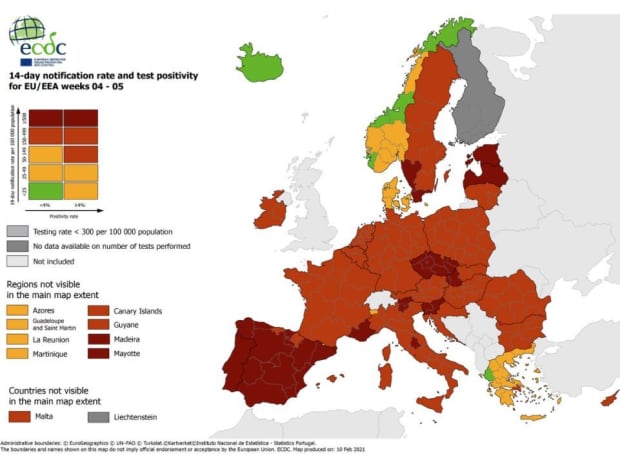
As elsewhere, Spain’s total circumstances are falling. Health Ministry information from Thursday confirmed a 14-day COVID-19 incidence charge of 320 per 100,000 for the nation, however over 456 per 100,000 for Madrid, making it the second worst region behind Melilla. That is because the nation slowly will get its vaccination program transferring amid current provide points throughout Europe.
According to El País, Madrid’s infection charges are worse than many fellow European capitals, comparable to Paris, Brussels and Rome, and much increased than Berlin’s. (See the under Feb. 10 map from the European Union.) France retains a 6 p.m.–to–6 a.m. curfew in place, whereas Germany and the U.Ok. are solely now beginning to think about easing their very own “hard lockdowns.”
As for what it appears like on the bottom, a current weekend in Madrid with springlike climate drew excessive demand for coveted outside tables. In the favored central La Latina district, there was a definite night-before-Prohibition really feel, as boisterous crowds rushed to cram of their socializing earlier than the ten p.m. curfew.
With tourism absent, restaurant and bar homeowners listed below are determined to make up for misplaced income, whereas locals appear simply as keen to make up for misplaced residing through the pandemic. It could be arduous to resist what one observes everybody else doing.
In a uncommon outing with mates, we walked an hour to discover an empty outside desk, then in the end shifted to indoor seating. Spain has had a strict masks coverage because the summer season, however face coverings usually are not required whereas consuming and consuming. In this explicit eatery, masks utilization was sporadic amongst prospects.
Read: UN chief joins WHO in slamming rich countries for hogging COVID vaccines
It was solely afterward that our group kicked ourselves a bit for taking pointless probabilities, as we mentioned the distinction between full-of-life Madrid and the state of affairs in the remainder of Europe.
“We are learning to live with death,” mentioned Oscar Durán, a buddy who works within the movie business right here. “We had hundreds of people dying a day. Now it’s not as tragic or dramatic as the first wave.”
Madrid was one of many first wave’s early epicenters, with greater than 900 individuals dying in a day at its peak. As Durán defined, Western nations comparable to Spain select to live with the virus and loss of life, versus nations in Asia, for instance, or New Zealand, which take strict measures and halt economies to protect life and stamp out infections.
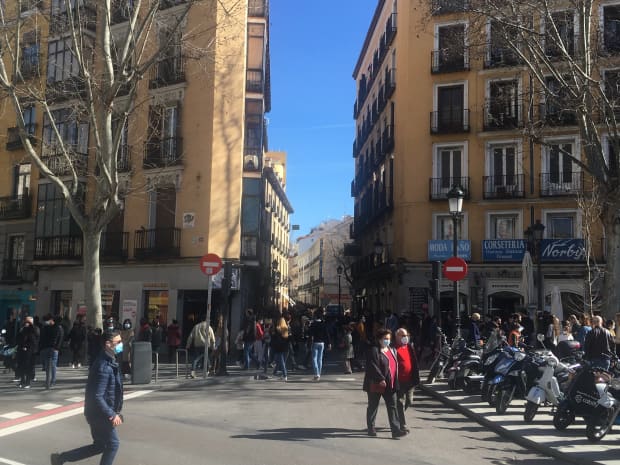
A busy Valentine’s Day in Madrid’s La Latina district.
MARKETWATCH/KOLLMEYER
“We simply are accustomed to a certain number of people dying a day. Right now it seems OK that we have 300 deaths a day, because it’s less than 900,” mentioned Durán. “Here in Madrid, with many deaths, people are arguing about whether bars should close at 10 p.m. or 11 p.m. And that seems crazy to people in countries such as Japan, Korea or New Zealand. For them, they want to avoid outbreaks and death.”
Daniel Sorando Ortín, a professor within the applied-sociology division on the Complutense University of Madrid, acknowledged that Spain’s capital metropolis is considerably of an outlier. “To start with, this is the place where more people died, both in absolute terms and in relative terms [as a proportion] of the population, so it makes a difference. And being that, it is a region with less restrictions. And I think that the combination of a lot of this and very weak restrictions, it helps people to understand [and] to live with it,” Ortín instructed MarketWatch in an interview.
The region’s premier, Ayuso, who hails from the center-right People’s Party, is understood for pushing again towards tighter restrictions and nearly came to blows with the central government in October 2020. Her argument is that the economically hard-hit metropolis wants to preserve going.
Ortín recalled last May’s protests-by-car within the wealthier Madrid district of Salamanca, the place members railed towards the federal government’s dealing with of the virus, which included one of many world’s strictest lockdowns. At the time, he mentioned, Ayuso’s response was that maybe the entire of society shouldn’t cease for a small at-risk portion.
“It has a socioeconomic axis, because for example we know poor people have a higher likelihood than wealthy people, so wealthy people say, ‘Don’t impose restrictions on us because we know how to handle it,’ ” he mentioned, including that it’s the identical for younger individuals, particularly these in additional stable socioeconomic circumstances, who additionally really feel much less in danger and don’t need to have their actions restricted.
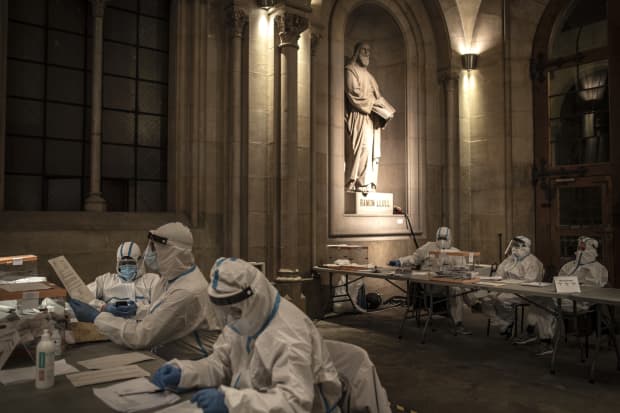
Election employees put on protecting tools through the closing hour of regional voting to enable those that are COVID-positive or who’re in quarantine to solid ballots, at Barcelona University, on Feb. 14.
Getty Images
When you’re listening to the federal government continuously let you know that you just shouldn’t cease consuming or consuming or having fun with life, then it’s simpler to perceive why individuals have “learned to live with deaths,” Ortín mentioned, although he added many in Madrid are struggling financially and never frequenting eating places. Meanwhile, different Spanish areas are observing far tighter COVID-19 restrictions.
“For example, I have family in Aragon and La Rioja, and the bars and restaurants are closed, and you cannot enter into the city of Zaragoza. So the approach is so different institutionally, it has to have effects on the behavior of people, in my point of view,” Ortín mentioned.
As for the virus itself, Madrid will nonetheless be dealing with elevated transmission by new variants, such because the U.Ok. one which now accounts for one in 5 infections in throughout Spain, Dr. Vicente Soriano, director of the UNIR Medical Center in Madrid, clinician and professor of infectious ailments on the UNIR Health Sciences School & Medical Center, instructed MarketWatch.
“The virus is moving to endemicity, and it seems that is here to stay for a while to become endemic, as the other four human coronaviruses that cause winter colds. Reinfections with less severity will become the rule. It would take two to three years,” mentioned Soriano.
Source Link – www.marketwatch.com
source https://infomagzine.com/learning-to-live-with-death-spains-capital-region-loosens-covid-19-restrictions-despite-elevated-infection-figures/


No comments:
Post a Comment